It’s a Tuesday night in Auckland, and Tuvalu community member Rosie Lameko sits weaving together flower petals in shades of red, yellow and white, creating traditional adornments that carry stories of her homeland.
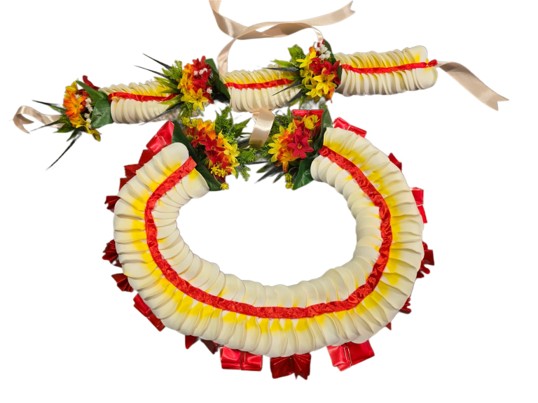
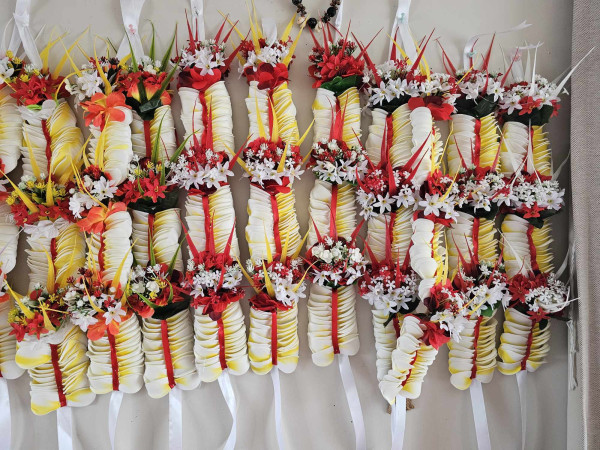
What started as a side hustle has now grown into a small business, with Rosie creating traditional adornments including the fau, a Tuvalu head garland, as well as traditional neck adornments.
But for Rosie, making these adornments has become more than running a business. It has given her a way to reconnect with her culture, uncover traditions she once knew little about and help carry them forward for the next generation.
At just eight years old, Rosie moved to New Zealand from Tuvalu. She learned the craft from her husband’s grandmother, who was willing to share her knowledge with her.
“When I came to her, she was really happy that I wanted to learn and also share the traditions with me. It started off with her showing me, and now I make them on my own,” says Rosie.
She says learning how to create the traditional fau has helped her build a stronger connection to her Tuvalu culture.
What Rosie enjoys most about making the adornments is learning the meaning behind the colours, the different weaving techniques and what they represent for each village.
“When I was younger, I didn't really know or care at first about what the design meant. But now that I've learned the craft, I've also learned the techniques and the meanings behind how they are made,” says Rosie.
One design Rosie creates includes a ribbon representing the two villages of Vaitupu, with the red ribbon symbolising the church situated between them in Tuvalu.
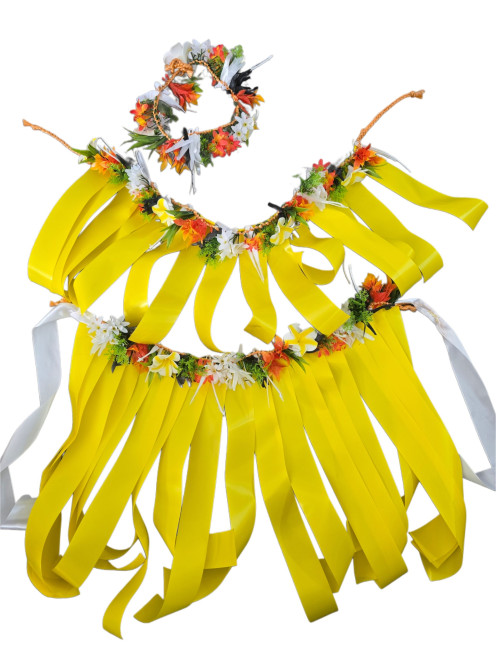
For another design associated with Nanumea, another village in Tuvalu, it is the flowers themselves that carry meaning, with fragrant flowers and plants traditionally selected for the headpiece.
Those details have given Rosie a greater understanding of the traditions she is helping to pass on to the next generation.
Her business has also become a way for others to connect with Tuvaluan culture.
While some of her customers are family, around 70 per cent are people she does not know personally. Some reach out because they have married into Tuvalu families and want to bring elements of Tuvalu culture into their own family life.
“It’s like they're connecting to our Tuvaluan culture and I'm always privileged to provide that access for our Tuvalu people and people who are willing to embrace our culture.”
The importance of keeping those traditions alive became even clearer after Rosie returned to Tuvalu recently for the first time in more than 20 years.
“I had this realisation that my children or even my grandkids might grow up not knowing what our traditions are or how to speak our language. That’s my inspiration to keep going. To keep making our adornments.”
One saying Rosie heard while studying at university has stayed with her over the years and continues to shape how she thinks about the connection between language and culture.
“When I was at university, I remember a saying: ‘Without my language, I cannot live my culture. Culture is like oxygen.’ That has stayed with me for years. It reminds me why it’s important for me to speak Tuvalu.”
Her advice to the next generation of Tuvaluans is simple.
"Put yourself in a space where you're able to conversate in Tuvaluan or be able to read in Tuvaluan.
Because if we're not in the correct spaces, we will never be able to access our language or be exposed to our culture. Be proud of our culture. There's a lot to uncover.
The more you uncover, the prouder you'll feel. That’s what I’ve learnt over the years.”