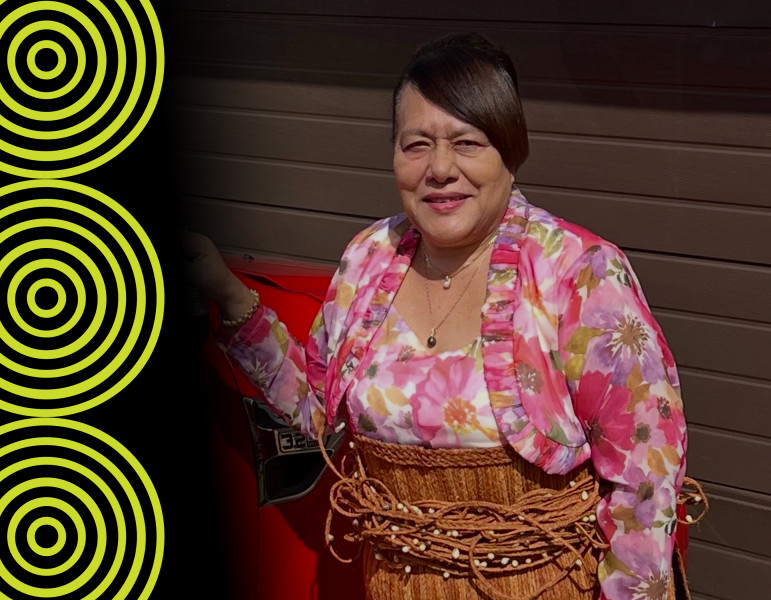
From classrooms to the stage, Fane Fusipongi Ketu'u is exchanging her pens for an honour as a Member of the New Zealand Order of Merit.
As a proud Tongan, Fane has spent decades advocating for the preservation of Lea Faka-Tonga (the Tongan language), as well as Tongan art and culture in Aotearoa New Zealand.
"I really can't explain the excitement, the feeling that you matter in your society. I have been given this honour, but this is one for the Tongan community, because everything I did, I did with the support of my colleagues, the Tongan teachers I work with on the Tonga Stage at Polyfest and the language teachers who promote Lea Faka-Tonga across schools. It's a team effort," says Fane.
For Fane, language is about much more than communication – it is the foundation of identity and your sense of belonging.
"As one great man said that when you speak to someone in English, it reaches their mind or their brain. But when you speak to someone in their own language, it reaches the heart. It speaks to the heart.
Language is more than words. It carries our identity, our history, our values, our genealogy, and the wisdom of our ancestors. Every time we teach and learn our language, speak it with pride, and make sure you pass it on to the next generation as it strengthens who we are as Tongan people.”
Fane said language helps young people remain grounded in their culture and traditions while maintaining strong connections with their relatives in Aotearoa as well as in the islands.
"It takes a village to raise a child. So to me, to be able to still connect with our historical village and place of origin, you need to be able to speak your own language in order for one to maintain those strong ties with your kāinga (family)."
A teacher by day and language advocate around the clock, Fane has consistently found ways to uplift Lea Faka-Tonga in schools and communities across Aotearoa.
As part of a wider group of educators and language experts, Fane contributed to the development of Lea Faka-Tonga Achievement Standards, supporting the inclusion of Tongan language within NCEA and tertiary education pathways.
Fane has also worked with the Ministry for Pacific Peoples to develop Lea Faka-Tonga language resources and educational books that support language learning and revitalisation. Her contributions to the Ministry's Pacific Languages portfolio have helped advance its priority to preserve Pacific languages for future generations.
One of the most visible examples of her work has been through ASB Polyfest, the largest Pacific cultural festival in the world. Since 2005, she has served as the Tongan Stage Coordinator, championing Tongan culture through dance, music and language at the annual event.
For 20 years, she has supported more than 40,000 students who have taken to the Tonga stage with pride and confidence under her guidance, empowering young people year after year to celebrate their language, culture and identity.
"For me to be recognised nationally as an educator who promotes and teaches Lea Faka-Tonga is very special. I did what I did because I love being a teacher and I love helping our young people to succeed in whatever it is that they want to pursue. That has always been my vision."
Through her work in schools and communities, she has ensured Lea Faka-Tonga continues to be heard, practised, and valued.
“It's very important that we remember that language is our connection to our roots, our culture, and customs. Without that, we are floating and we have no roots. Our language is the root that binds us to where we are from.
As I reflect on receiving this King’s Birthday Honour, I do so with a heart full of gratitude and humility. I accept this recognition not only on my own behalf, but on behalf of those who have walked this journey with me – my parents and family, my colleagues, my students, my community, and especially the many people who have dedicated themselves to preserving and promoting our beautiful Lea Faka-Tonga.
My hope and prayers are that this honour will inspire others to continue championing our Pacific Languages and cultures. Our young people deserve to know that their language is a gift, a source of strength, and something to treasure with pride.”